

Is tape backup dead? The rise of cyber threats has led to a long list of requirements for creating a business continuity plan. However, tape is not dead; many companies still use it to meet regulatory audits.
In our view, tape has not lost its value; it has simply been mispositioned. Its strengths lie in its durability, cost efficiency, and offline storage, which make it ideal for long-term retention. The real challenge for organizations today is how to reposition tapes within a modern data protection architecture. Tapes should complement, rather than compete with, modern backup solutions.
Updated role for tapes: Long-term data retention
Tape has been used in enterprise environments for decades and continues to evolve through successive Linear Tape-Open (LTO) generations, from early formats to today’s LTO-10. Designed to store large volumes of data at a relatively low cost, tape is optimized for low-access scenarios, where data is written sequentially and then left untouched for long periods of time. Modern tape media also offers long usable lifespans—often 30 years or more.
These characteristics limit tape’s effectiveness as a primary backup solution when rapid recovery is required, particularly during cyber incidents. However, they align well with long-term retention needs. For data that must remain unchanged and accessible over many years to meet audits or regulatory requirements, tape provides durable storage with predictable costs. Its low energy consumption helps to control long-term expenses, while its offline nature offers an additional layer of security against network-based threats.
>> Click here to learn what capabilities a modern primary backup solution must include
By clearly defining tape as a data retention solution and pairing it with technologies better suited for recovery, organizations can leverage each tool for a specific purpose and reduce unnecessary risk.
Using both tape and a modern backup solution for more reliable long-term data retention
Once tape is specifically used for long-term retention, daily backup and recovery should be handled by a modern backup solution instead. By combining different technologies, organizations can address both operational usability and long-term data preservation at the same time.
In this data protection architecture, the role of a modern backup solution becomes essential. ActiveProtect, Synology’s all-in-one backup appliance, is designed to centralize daily backup operations and management while creating a stable foundation for off-site copies and long-term data retention. Organizations can store primary backups via ActiveProtect and replicate a secondary copy to remote storage with ActiveProtect Vault. Existing archive software, such as ArchiveWare, can then be used to export data from remote storage to tape for archival purposes.
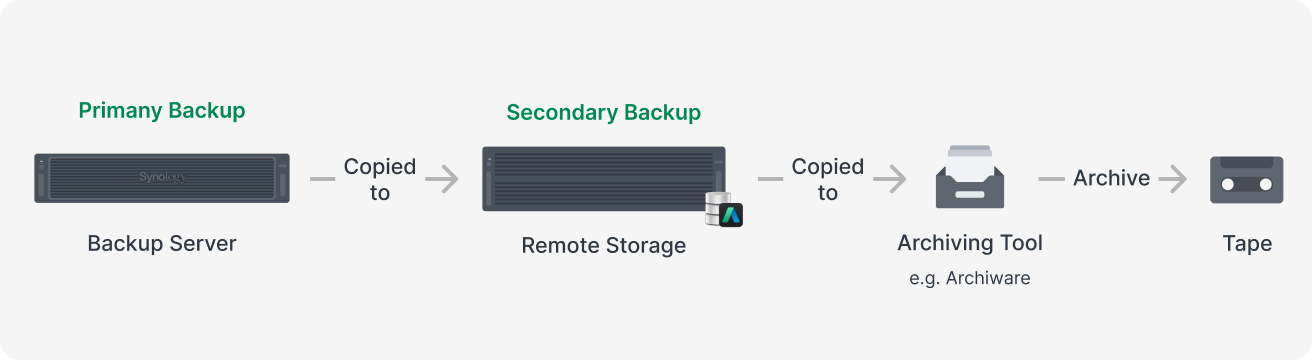
As the secondary backup is encrypted when copied to the remote storage, data written to tape remains encrypted for long-term retention, helping to secure data when archived. This layered design allows organizations to retain the long-term value of tapes while keeping recovery and daily management operations within a modern data protection platform that offers greater speed and control.
Note that tape as a final archival layer still introduces operational overhead. Physical handling of media, storage conditions, and periodic read verification all require continuous maintenance. Regular verification—such as monthly reloading and test reads—is recommended to reduce the risk of discovering unreadable data years later.
Move beyond tape limitations with ActiveProtect
Even when tape is properly positioned for long-term retention, its reliance on physical media and manual workflows remains an operational burden. To address this, ActiveProtect is a modern alternative that achieves long-term retention without the inherent limitations of tape—while maintaining cost efficiency and usability.
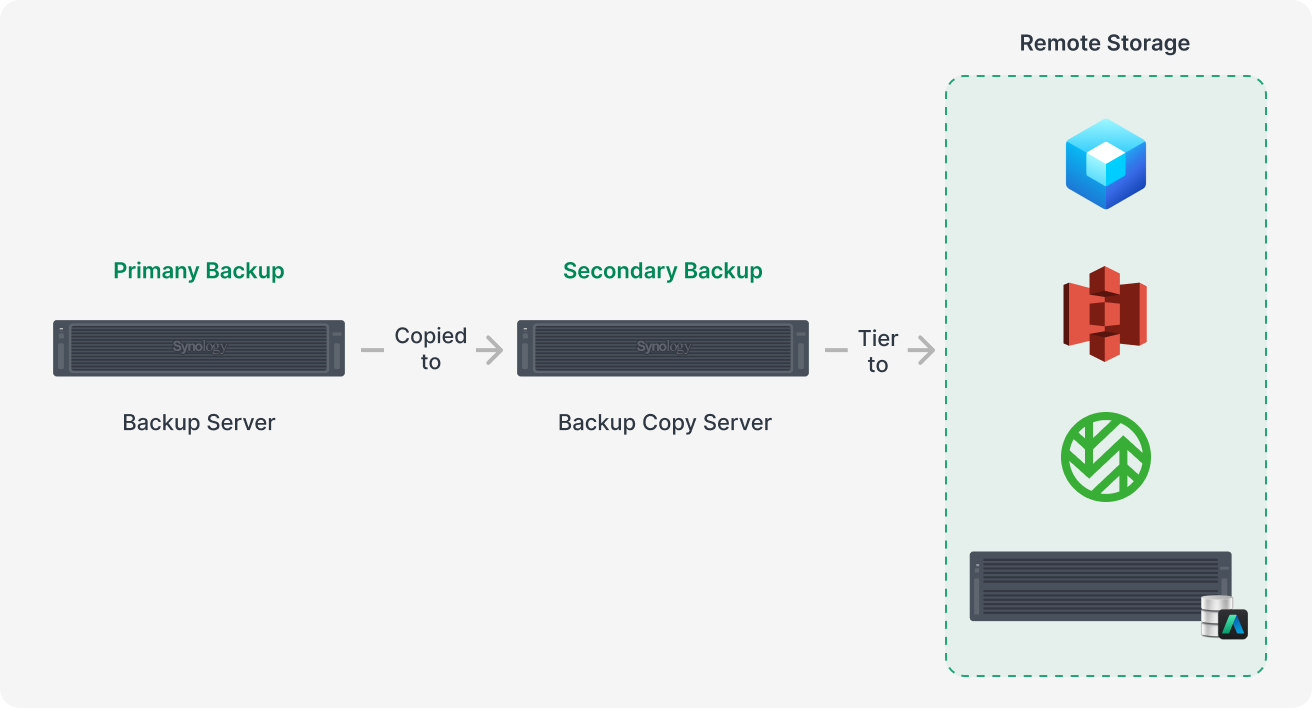
Organizations can continue to use ActiveProtect as the primary backup platform and replicate backups to an offsite backup server to meet the 3-2-1 backup rule and build an isolated recovery environment to automatically isolate secondary backups from the production site when needed to ensure business continuity. Click here to learn more about ActiveProtect’s isolated recovery environment.
Additionally, ActiveProtect allows users to validate backups directly from the management interface. Specific backup versions can be selected and restored onto a built-in sandboxed environment, enabling recovery validation without any impact on the production site.
Storage costs are a key concern for many organizations with long-term retention requirements., ActiveProtect’s tiering mechanism offers cost efficiency that is comparable to tapes. Older data can be automatically moved from the backup server to lower-cost remote storage option, allowing organizations to control long-term storage costs while remaining compliant with retention requirements. Moreover, the actual data volume can be reduced with built-in data deduplication.
>> Learn more about Synology ActiveProtect or consult with our team.