

Nearly 30% of MSPs are only breaking even, despite steady growth in the managed services market. Scaling up doesn’t automatically mean scaling profitably.
Most MSPs lose profits because backup operations cost more as they scale. The problem is not one major expense but a set of hidden costs that quietly increase month after month. Let’s break down where they’re hiding.
The 5 hidden profit killers
- Tool sprawl: Sometimes a backup solution only covers a limited range of workloads. Other times, vendors split features across separate products — one for VMs, one for M365, and one for endpoints. This forces you to stack tools to get full coverage. It increases both tool costs and management overhead. Multiple isolated consoles also increase the time spent just checking status, especially across clients.
- Complex, under-automated tools: A quick self-check: Are new workloads protected automatically? Does enabling immutable protection require extra setup? Can one backup policy cover the 3-2-1-1-0 backup standard? If the answer is “no,” that is where hidden costs creep in. An IT engineer must spend extra time and effort to complete that task. Complex interfaces also raise training costs. The more manual steps there are, the more chances there are for mistakes.
- Rigid storage architecture: Picture a customer who, for compliance reasons, needs backups retained for several years. Without tiering capabilities, you end up paying primary storage prices to store cold data indefinitely. Without deduplication, storage requirements can increase significantly, putting additional cost pressure on MSPs.
- Inefficient data transfer: This is the most overlooked killer as it doesn’t appear as a clear line item like a license fee. Many tools lack source-side deduplication; when client data is backed up entirely into an MSP-hosted environment, insufficient bandwidth planning triggers overage fees.
- Stacking licensing models: Many backup vendors charge separate fees for protected devices, users, storage capacity, and advance features. As customer environments grow, licensing costs grow as well — so scaling up doesn’t translate into better margins.
Fortunately, these profit killers are avoidable, and don’t require a five-point internal overhaul. Instead, choose a backup platform designed to avoid these traps from the start.
How ActiveProtect turns profit killers into profit drivers
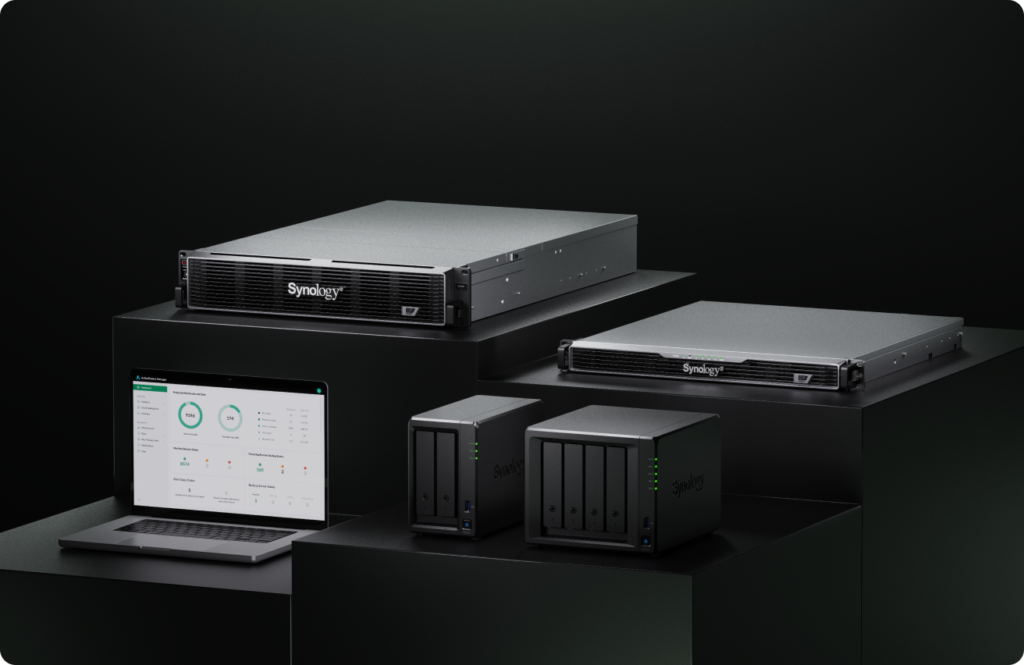
ActiveProtect is Synology’s all-in-one backup appliance that simplifies data protection. While simplifying operations, it also helps MSPs keep costs predictable and become more profitable as their business grows.
A single platform, centrally managed
ActiveProtect is built as one solution for all MSP services, covering physical devices, VMs, IaaS, SaaS, file servers, and databases without stitching together separate tools.
Additionally, a centralized console allows MSPs to manage every customer from one interface while applying multi-tenant protection policies. Daily automated summary emails report backup success rates without anyone logging in to check manually.
Simple and automated operations
ActiveProtect automates the entire backup lifecycle, reducing the manual work required to manage backup services at scale.
Firstly, when new workloads are added, Auto-Protect automatically finds them and applies predefined backup policies. If an immutable protection plan is applied, immutable protection is enabled automatically, with the lock period aligned with the configured retention policy.
After each backup, backup verification automatically boots the recovery point in the built-in sandbox to validate recoverability and record the process for SLA reporting.
Lastly, ActiveProtect automatically cleans up backup data when source workloads are removed or retention periods expire, reducing ongoing administrative work.
By automating protection, verification, retention, and cleanup, ActiveProtect helps MSPs reduce operational effort, minimize the chance of human error, and scale more efficiently.
Balance storage efficiency with long-term retention
ActiveProtect minimizes storage consumption with SURE technology, combining incremental backups with multiple layers of deduplication. The result: Up to 80% storage savings, significantly reducing infrastructure costs.
For long-term retention, ActiveProtect automatically tiers older backup versions to lower-cost object storage solutions such as C2 Object Storage, Wasabi Cloud Storage, and other S3-compatible storage, allowing old data to be stored more economically. To further optimize capacity, GFS retention policies keep only the recovery points required for compliance instead of retaining every backup version.
Intelligent and global traffic control
Source-side deduplication minimizes the amount of data transferred before it leaves the customer environment, reducing network costs.
Even when the volume of data is very large, ActiveProtect provides rule-based traffic control, allowing MSPs to define bandwidth limits on a per-tenant or global basis. Intelligent bandwidth allocation then dynamically distributes available bandwidth across concurrent backup jobs, preventing network congestion while avoiding unexpected transfer costs.
Predictable costs, better margins
Unlike many traditional backup platforms, ActiveProtect uses a one-time hardware purchase model, with no additional fees for advanced features or recurring software fees based on the number of devices, accounts, or storage. This gives MSPs greater flexibility in pricing and more room for profit. Based on publicly available pricing, ActiveProtect’s total cost of ownership can run up to roughly 7x lower than competing solutions.
Learn more: 3 overlooked BaaS & DRaaS features MSPs can monetize—without additional costs